The 1% problem
Who actually profits on Polymarket

The Uncomfortable Truth
We analyzed 242,640 Polymarket traders across 2.68 million positions.
Here’s the headline: 72% of traders are profitable.
Sounds great, right? Most people make money. The average profit is $1,580. Prediction markets work.
But look deeper. The distribution tells a different story—one that challenges everything you think you know about who wins in these markets.
The Gini Problem
The Gini coefficient for Polymarket profit distribution is 0.865.
For context:
0.0 = Perfect equality (everyone earns the same)
1.0 = Perfect inequality (one person has everything)
United States income: ~0.39
South Africa (most unequal major economy): ~0.63
Polymarket: 0.865
At 0.865, Polymarket’s profit distribution is more unequal than any national economy on Earth.
But that number understates the reality. Let me show you why.
The Numbers: A Complete Picture
Here’s the full percentile breakdown from our analysis:

The standard deviation is $1.25 million.
When the standard deviation is 4x the median, you’re not looking at a normal distribution. You’re looking at a power law.
The Shape of the Distribution
The profit distribution looks nothing like a bell curve. It’s a power law with extreme concentration:
Volume Concentration (Lorenz Curve Data)

The bottom half of all traders combined account for 0.3% of total volume.
Profit Concentration

Half of all profits flow to just 25 traders.
The Elite: A Deep Dive
We identified the top 20 performers. Here’s what separates them:
Top 20 Polymarket Earners
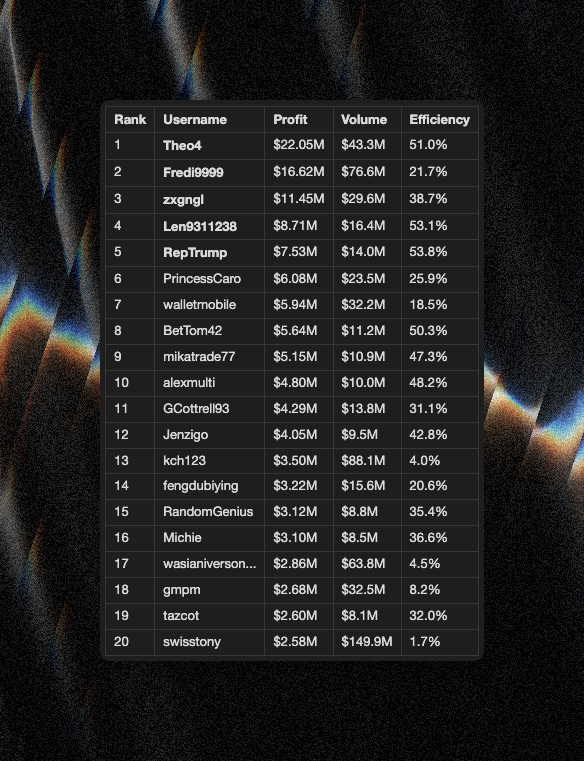
Efficiency = PnL ÷ Volume (profit per dollar traded)
Patterns in the Top 20
Efficiency variance is extreme:
Theo4: 51% efficiency (turns $100 traded into $51 profit)
swisstony: 1.7% efficiency (turns $100 traded into $1.70 profit)
Both are in the top 20. How?
Two distinct strategies emerge:
High-conviction traders (Theo4, RepTrump, BetTom42): Trade less, win big
High-volume traders (swisstony, kch123): Trade massively, win small percentages
The high-conviction traders made more money with less capital at risk.
The Volume Whales
The highest-volume traders aren’t necessarily the most profitable:

The top 10 volume traders account for 26% of all platform volume.
But notice: only one of these (swisstony at $149.9M) appears in the profit top 20.
Volume ≠ Profit. The biggest traders are often market makers or high-frequency participants, not directional bettors.
Why Does This Happen?
1. Skill Compounds Exponentially
If you have a 5% edge and trade $1,000, you make $50.
If you have a 5% edge and trade $10,000,000, you make $500,000.
Same edge. 10,000x different outcome.
Elite traders identified their edge and scaled it. Others couldn’t—either because they didn’t have edge, or couldn’t access capital.
2. The Hot Hand Is Real
Our analysis found strong evidence of hot hand effects:
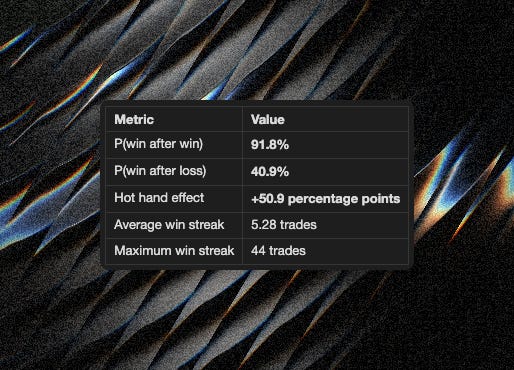
Winners keep winning. The difference between 91.8% and 40.9% is enormous.
This isn’t momentum—it’s skill revealing itself through sequential outcomes. Good traders have consistent edge; bad traders don’t.
3. Information Advantages Persist
In traditional markets, information advantages are quickly arbitraged away.
In prediction markets, information advantages can persist. The person who understands Pennsylvania polling better than anyone can exploit that edge repeatedly across dozens of related markets.
4. Winner-Take-Most Dynamics
Many prediction market opportunities are zero-sum. When one trader identifies a mispricing before others, they capture most of the profit. The second-mover gets scraps.
The Favorite-Longshot Bias: Where Edge Lives
Our win rate analysis by price bucket reveals systematic patterns:

Longshots (0-30%) beat expectations by 31.7 percentage points on average.
Favorites (70-100%) beat expectations by 12.3 percentage points.
The elite traders systematically identify underpriced longshots. This is where alpha lives.
The Specialization Paradox
79.6% of traders are highly specialized (Herfindahl Index > 0.5).
Category breakdown of positions:
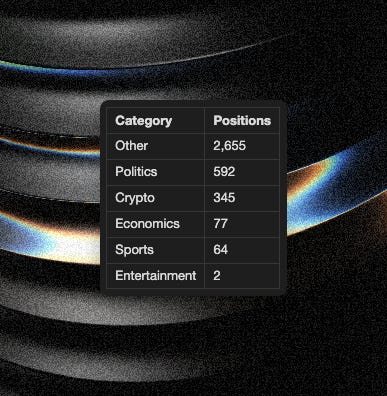
The top earners specialize in politics—the one category where deep expertise translates directly to edge.
But here’s the paradox from our Generalist analysis:
Generalists (5+ categories): 124x returns
Specialists (1 category): 2x returns
How can both be true?
The answer: Political specialists are outliers. Politics is the rare domain where:
Information is genuinely scarce
Expertise translates to edge
Market opportunities are frequent and large
In every other category, generalism wins.
Skill Persistence: Does Edge Last?
We tracked whether early performance predicted later performance:

Only 28.6% of top-quartile early performers remained in the top quartile later.
Interpretation: Short-term success doesn’t predict long-term success. The market adapts. Edge degrades. Even the elite must continuously find new advantages.
What This Means For You
The Harsh Reality
If you’re trading prediction markets recreationally, you’ll probably make money—but not much.
The median outcome across all profitable traders is $27,695. That sounds good until you realize:
The mean is $316,154 (skewed by whales)
The top 1% starts at $4.9M
You’re competing against people who turned $43M volume into $22M profit
The Opportunity
The extreme concentration also means the rewards for edge are enormous.
If you can identify consistent mispricing—through better information, better models, or better timing—you can move from median to elite.
The gap between “average” and “excellent” is wider than almost any other trading venue.
Questions to Ask Yourself
What is your edge? Can you articulate it specifically?
Is your edge scalable? Can you trade more without degrading returns?
Is your edge persistent? Will it work next year?
Are you in the right category? Politics rewards specialists; everything else rewards generalists.
If you can’t answer these clearly, you’re gambling, not trading.
The Bigger Picture: Comparison to Other Markets
The 1% problem isn’t unique to prediction markets. It’s characteristic of:

Prediction markets sit at the extreme end of skill-based competition.
The difference: prediction markets are new enough that edge opportunities haven’t been fully arbitraged away. The top 1% haven’t been competing against algorithms for 30 years.
That window may not last forever.
Methodology
Data source: Polymarket API + Dome aggregator
Traders analyzed: 242,640
Positions analyzed: 2,687,493
Time period: 2021-2024
Metrics calculated:
PnL distribution (mean, median, percentiles)
Gini coefficient via Lorenz curve
Win rates by price bucket
Hot hand analysis (sequential outcomes)
Specialization via Herfindahl Index
Skill persistence via rank correlation
Full code available at github.com/kluless13/pm-data-analyses
The Bottom Line
72% of Polymarket traders are profitable.
But:
Median profit among top traders: $27,695
Top 1% threshold: $4.9M+
Gini coefficient: 0.865
Top 10 traders: 34% of all profits
The prediction market economy isn’t a market where most people win big. It’s a market where almost everyone makes modest returns while a tiny elite captures massive profits.
The question isn’t whether you’ll make money.
It’s whether you’ll be in the 1%.
And if you’re not willing to develop genuine, scalable, persistent edge—you already know the answer.
Based on analysis of 242,640 Polymarket traders across 2,687,493 positions.